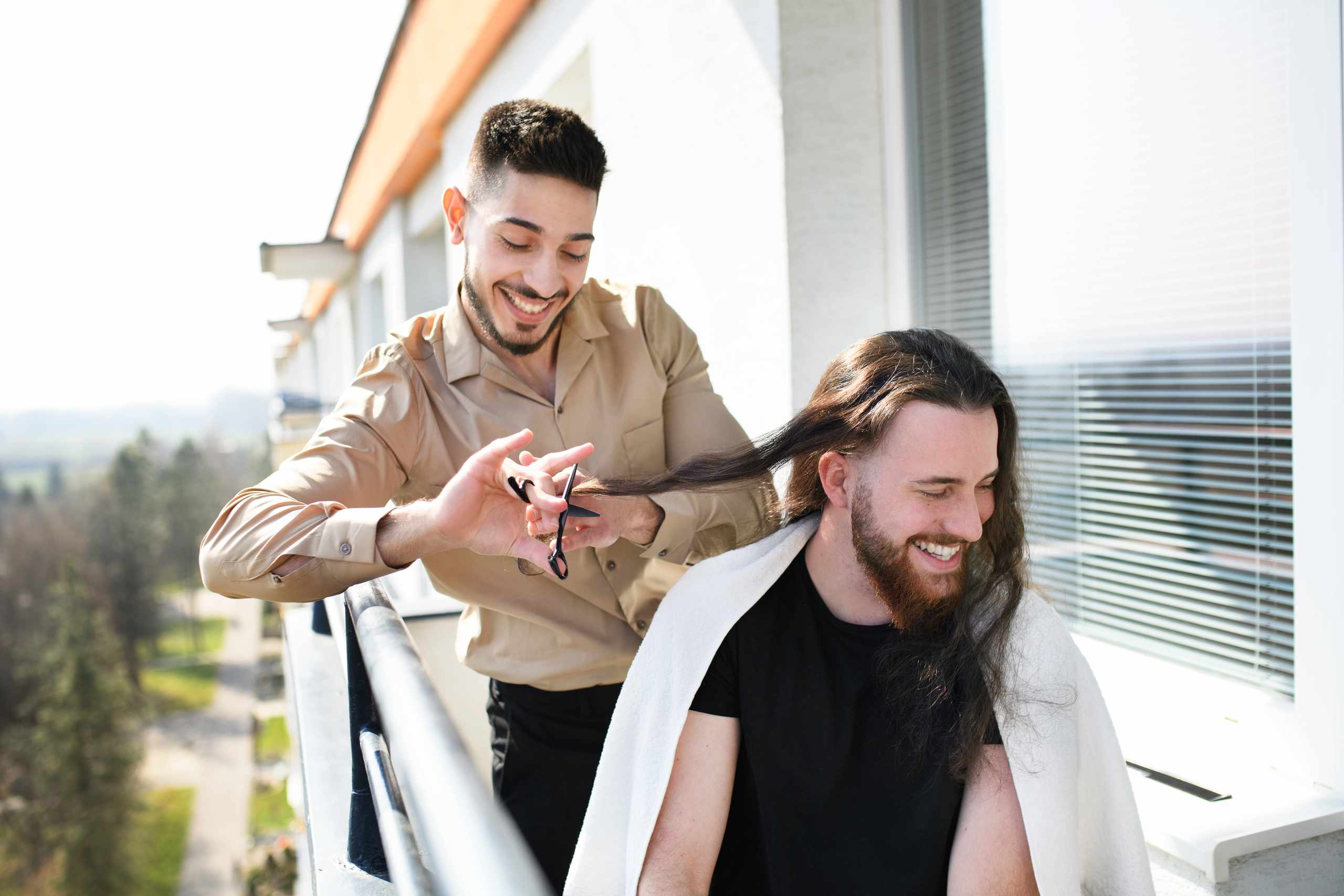
If there is one thing that will make your hairdressing skills look amateurish, it is having an uneven cutting line. A haircut that appears to be a nice, straight line when wet and in a client’s hand can suddenly look uneven when dry, especially on the perimeter or at the corners. Beginners often don’t realize what caused the line to become uneven, and in most cases, the error does not start with the actual cut, but with the process leading up to it. The hairdressing mistakes that make lines uneven include lack of tension, moving body parts (especially the head), and trying to cut too much hair at once. If a line is not evenly cut and controlled, then the next lines on top cannot sit correctly on it either.
Developing even lines is about seeing and creating an even result rather than rushing the actual process. The first step toward an even cutting line is to be consistent rather than applying pressure. Ensure that when you comb the hair down, the tension is the same on either side of the hair. In case you are not even, one side of the cut will look shorter when the tension is released from that side. Try it on one small center section of the nape area instead of the entire width. Make sure the hair is combed straight down. Hold your cutting fingers against the hair with minimal tension. Cut the hair once and release it. Check the line of the cut in the hair. It should be an even line. Only after that is you can proceed on to the next subsection. If you are unsure of what it should look like, it can be easy to move forward blindly.
After checking the cut of the center section, move on to a side section next to it, which should now be slightly longer than the center one. It is very important to cut a bit from the center section to use as your guideline, but just a small bit. This section-to-section relationship is what will result in an even cutting line over the whole perimeter. A common occurrence is for the client to lift their chin, which makes the hair fall and creates an uneven line. This needs to be addressed before the hairdresser even lifts the scissors. If you feel unsure about cutting an even line, stop cutting and check your client’s head before every section.
In other cases, you might be holding your fingers out to one side when you reach the end of the cut. When this happens, your fingertips are not at a 90-degree angle to the desired cut line, which results in unevenness in the cut line in the long run. Again, the correct response is to hold the head straight and check it every time before cutting. Do not lean to the side, but move the body instead. If you continue to get an uneven cut at the corner every time, it is likely due to either not combing the hair to its natural fall or to the incorrect cutting angle you are holding the fingers at. It takes very little effort to cut a straight and even line once you slow down enough to catch any of these errors.
If you only work a small amount of hair and only check after every small subsection, your skills will develop faster than if you cut too much and try to fix the errors as you go. Take a few minutes to set up the nape section and clip all other hair out of the way. Now cut only three or four sections of this same area, checking to make sure each cut is an even line before proceeding to the next. Repeat this process with the exact same three or four subsections, but focus specifically on your body positioning and tension. Do not try to fix the whole perimeter in one cut. Try to work on one specific thing at a time, and it will be much easier to find the problems that arise.
You can avoid getting into bad habits of repeating errors over the same section of a haircut. In some instances, you may end up with an uneven cut even though you were very careful to check your hairdressing. Do not just keep trimming the hair until it appears even because you end up taking more hair than you should. You may think the longer section is shorter than it really is and cut too much. Instead, lightly dry the hair and comb it down to its natural fall, then identify where the problem areas are. Fix only those specific problem areas. Hairdressing is best when you are careful to see what you are cutting rather than trying to cut too fast without seeing what the problem areas are. Even lines take calm repetition of checking, seeing, and fixing the problem areas in hair to get right.